Building an AI Agent System for Restaurant Owners: Why I Chose an Agentic Framework Over Traditional Solutions
Building an AI Agent System for Restaurant Owners: Why I Chose an Agentic Framework Over Traditional Solutions
The Problem: A Café Owner's Frustration
A friend introduced me to a café owner who was dealing with a common issue: getting insights from their business data took too long. His managers would pull reports, analyze them, and present them—a process that drained time and slowed decisions.
The conversation made the problem clear: business owners need instant, conversational access to their data, not reports that arrive hours or days later.
The owner wanted to ask questions like:
- "Show me how coffee sales changed after we raised prices"
- "What are our top-selling items this month?"
- "How's our inventory looking for the most popular menu items?"
Each query required manual work: query the database, analyze results, format a response, and create visualizations. This wasn't scalable.
First Conversation with Café Owner
The Real Value: It's All About the Data
The framework is only as good as the data it connects to. The value comes from integrating with real operational systems that restaurants already use.
Why Pet Pooja?
Pet Pooja is one of the most popular restaurant management platforms in India, handling:
- Point-of-Sale (POS) transactions
- Inventory management
- Customer relationship management (CRM)
- Staff scheduling
- Menu management
- Real-time reporting and analytics
By building over Pet Pooja, we can leverage:
- Years of historical transaction data
- Real-time inventory levels
- Customer ordering patterns
- Menu performance metrics
- Staff productivity data
- Financial data
The agentic framework becomes powerful when it can access this operational data in real time.
Base System Architecture
The Solution: An Agentic AI System Connected to Real Data
I decided to build a system where specialized AI agents collaborate to answer business questions in real time, using natural language, connected directly to the restaurant's operational data.
Why Agentic Architecture?
After exploring options, I chose OpenAI's Agents SDK with an agentic framework for these reasons:
Specialized Agents for Different Tasks: Instead of one general model, I created specialized agents:
- Sales Agent: Answers sales questions, queries the database, and provides insights
- Inventory Agent: Handles inventory questions and stock analysis
- Plotter Agent: Creates visualizations when users ask to "see" data
- Response Agent: Formats final outputs for consistency
Agent Collaboration (Handoffs): Agents hand off work when needed. When the Sales Agent detects a visualization request, it provides analysis first, then hands off to the Plotter Agent with the data. This mirrors how teams collaborate.
Data Grounding: Each agent is constrained to use actual database results—no hallucinations. The Sales Agent must query before answering and uses exact numbers from query results.
Temperature Control: Critical agents use low temperature (0.1) for deterministic, data-grounded responses while maintaining natural conversation.
The Architecture
The system uses:
- Backend: FastAPI with OpenAI Agents SDK
- Database: Neon (PostgreSQL) with schema introspection
- Frontend: React + TypeScript with streaming responses
- Agent Orchestrator: Routes messages and manages agent collaboration
Key features:
- Streaming responses for real-time feedback
- Automatic visualizations when users say "show me"
- Database schema introspection so agents understand the data structure
- Session management to maintain conversation context
- Multi-agent handoffs for complex workflows
Integrating with Pet Pooja: The Data Pipeline
Pet Pooja's API capabilities enable seamless integration. Here's how the data flow works:
1. Data Export and Import
Pet Pooja allows exporting data in various formats. The system includes a CSV import utility that:
- Automatically infers database schema from exported data
- Handles batch imports for large datasets
- Sanitizes column names for database compatibility
- Supports incremental updates (append mode) for daily syncs
For example, a restaurant can export:
- Daily sales transactions
- Inventory movements
- Menu item performance
- Customer order history
This data gets imported into our PostgreSQL database where agents can query it.
2. Real-Time API Integration (Future)
Pet Pooja's API enables:
- Real-time transaction data sync
- Live inventory level monitoring
- Customer data access
- Order status updates
This means agents can answer questions with up-to-the-minute data, not yesterday's export.
3. Schema-Aware Querying
The system's schema introspection allows agents to:
- Understand table structures automatically
- Discover available data columns
- Write accurate SQL queries
- Handle schema changes gracefully
When a Pet Pooja export structure changes, agents adapt without code changes.
What Makes This Framework "Worth the Juice"
The real value comes from connecting the agentic framework to comprehensive operational data:
1. Real-Time Insights from Operational Data
Instead of analyzing stale exports, agents can access:
- Live sales data: "What did we sell in the last hour?"
- Current inventory: "Do we have enough flour for tomorrow's orders?"
- Customer patterns: "Which customers order the most during lunch hours?"
2. Cross-Domain Analysis
Pet Pooja's integrated data allows agents to answer complex questions:
- "How does inventory turnover correlate with sales peaks?"
- "Which menu items have the best profit margins considering ingredient costs?"
- "What's the relationship between staff scheduling and customer wait times?"
3. Historical Context
Years of Pet Pooja data enable:
- Trend analysis: "How have coffee sales changed seasonally over 3 years?"
- Pattern recognition: "What menu items typically sell better on weekends?"
- Predictive insights: "Based on last year's data, how much inventory should we order for Diwali?"
4. Business-Specific Intelligence
Pet Pooja's data includes restaurant-specific context:
- Menu structure and categories
- Pricing history and changes
- Promotional campaign impacts
- Multi-location performance comparisons
Agents understand this context and provide relevant insights.
The Integration Strategy
Phase 1: CSV Export/Import (Current)
Restaurants can:
- Export data from Pet Pooja (daily/weekly)
- Import CSV files using the provided utility
- Ask questions about their data immediately
This works for:
- Historical analysis
- Periodic reporting
- Data exploration
Phase 2: API Integration (Next)
Building direct API integration for:
- Real-time data sync
- Live querying without exports
- Automatic updates
- Webhook-based triggers
Phase 3: Native Integration (Future)
Working with Pet Pooja for:
- OAuth-based authentication
- Official API partnerships
- Seamless data flow
- Plugin/extension capabilities
The User Experience with Real Data
The café owner can now:
- Connect their Pet Pooja data (via export or API)
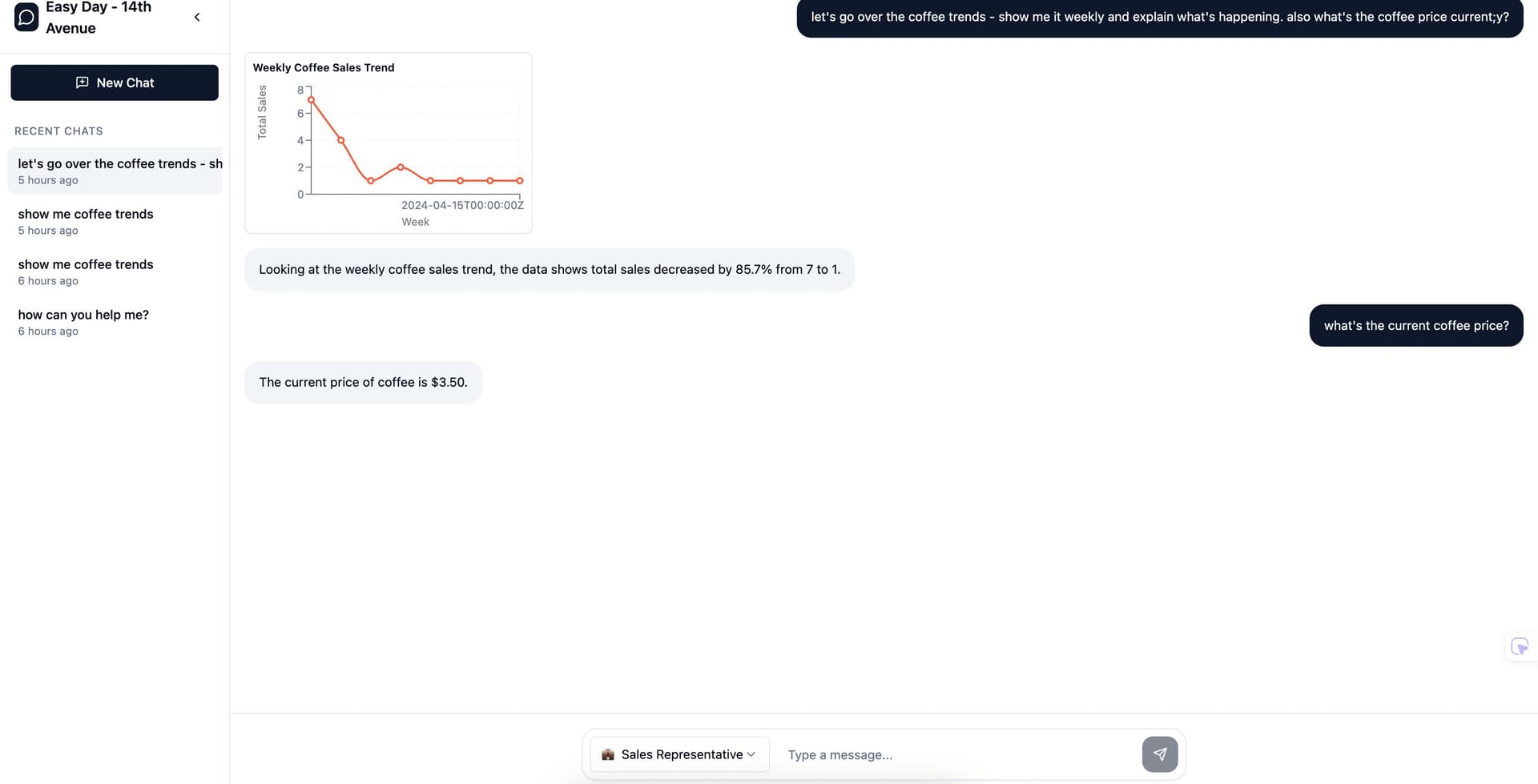
- Ask questions: "Show me coffee sales trends after our price increase"
- Get immediate analysis with exact numbers from their transactions
- See visualizations automatically generated
- Ask follow-ups that build on the conversation
All powered by their actual operational data.
Why This Matters
The agentic framework is powerful, but its real value comes from:
- Access to comprehensive operational data
- Integration with tools restaurants already use
- Real-time insights from live data
- Historical context for trend analysis
- Business-specific intelligence
By building over Pet Pooja, we're not creating another siloed system—we're adding an intelligent layer on top of existing infrastructure. Restaurant owners get:
- Zero learning curve (they already use Pet Pooja)
- No data migration needed
- Instant access to their business intelligence
- Natural language interface to their data
What I've Built So Far
The current system includes:
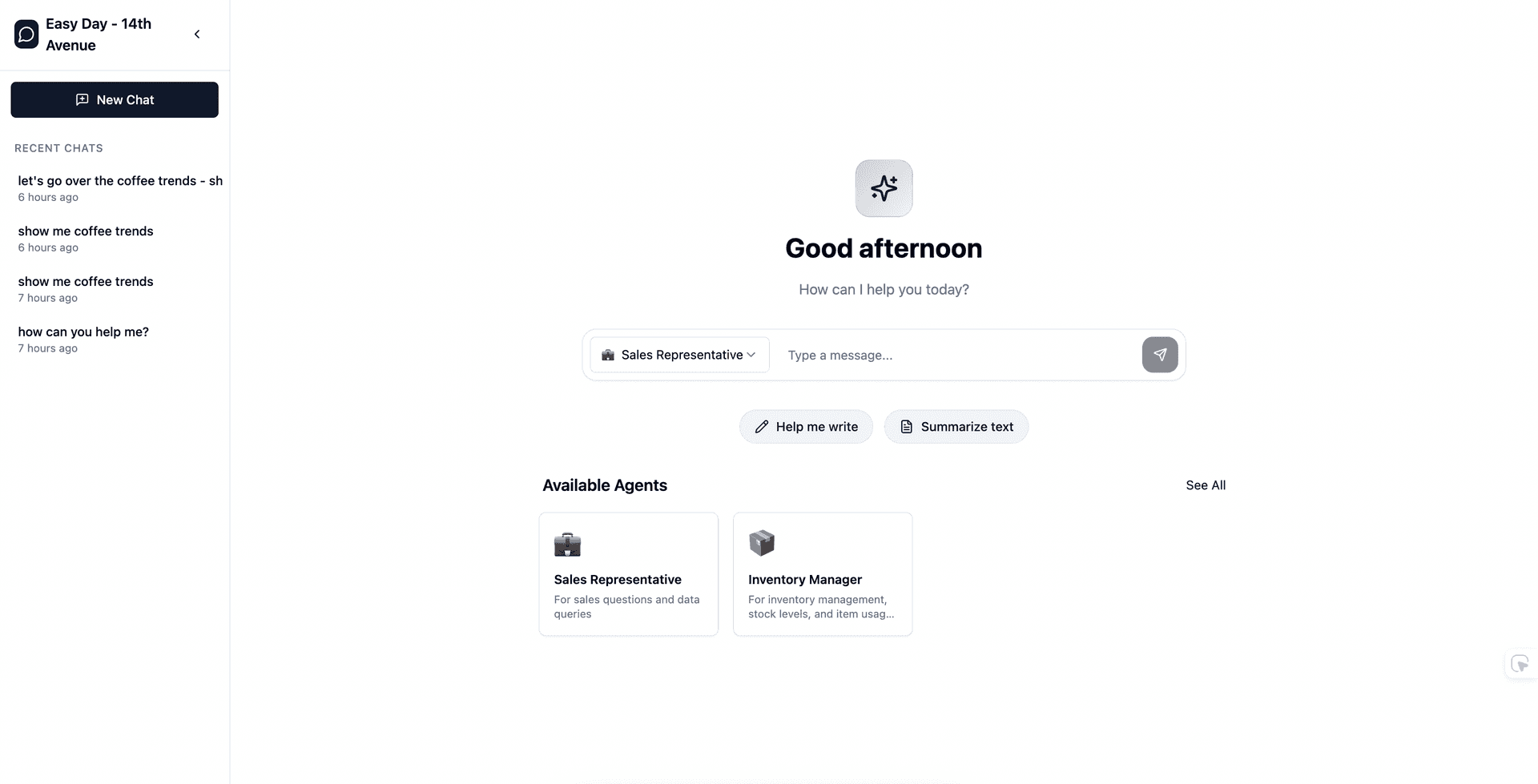
- Multi-agent orchestration with automatic routing
- Database query tools with schema awareness
- Automatic chart generation from natural language requests
- Streaming responses for real-time interaction
- Specialized agents for sales and inventory
- A clean React interface for conversations
- CSV import utilities for Pet Pooja data
The Future
This is just the beginning. The agentic framework makes it straightforward to add agents for:
- Financial analysis
- Menu optimization recommendations
- Staff scheduling insights
- Customer behavior analysis
Each new capability becomes a new specialized agent that collaborates with existing ones.
As we integrate deeper with Pet Pooja:
- Agents will understand restaurant operations better
- Real-time insights will become the norm
- Predictive analytics will guide decisions
- Multi-location analysis will scale easily
The agentic framework makes this possible, but the data makes it valuable.
Key Takeaway
Agentic architecture isn't just a technical choice—it's a way to model how humans work. By creating specialized agents that collaborate, we can build systems that feel natural, are reliable, and scale as business needs grow.
But the framework alone isn't enough. The real value comes from connecting it to comprehensive, real-world data. By integrating with Pet Pooja—a platform that restaurants already trust and use daily—we're not asking them to change their workflow. We're enhancing it.
For restaurant owners overwhelmed by data requests, this approach transforms hours of manual work into seconds of conversation, powered by the data they're already generating in their day-to-day operations.